By Scott Barnes: Senior Naturalist-Cape May Bird Observatory
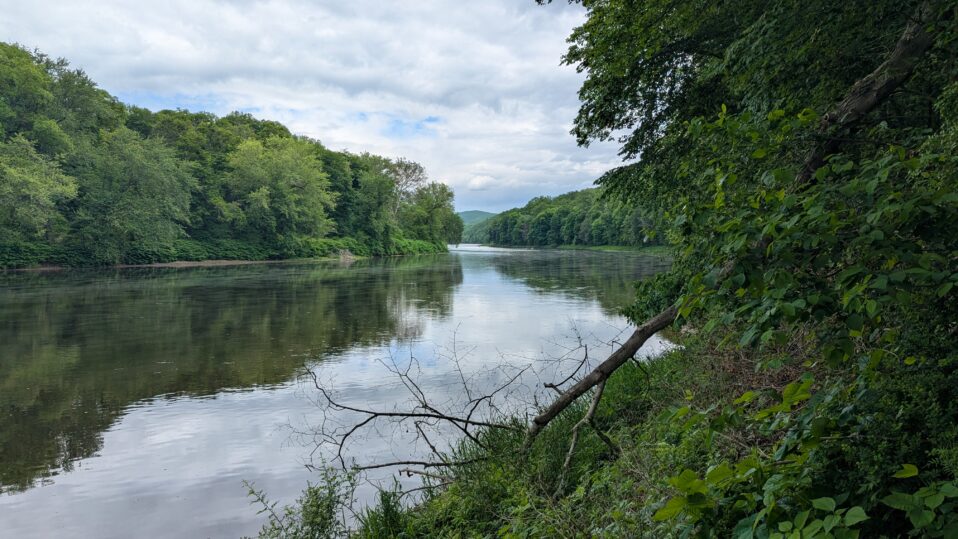
The Delaware River runs some 282 miles from the confluence of the east and west branches in Hancock, NY to Delaware Bay and is the longest undammed river in the eastern United States. Thankfully, a large portion of the river between I-80 and the point where New York, Pennsylvania, and New Jersey meet near Port Jervis is part of the Delaware Water Gap National Recreation Area.
The Delaware River plays a critical role for American Shad, anadromous fish that travel from the open seas upriver to spawn in late spring. Photo by Scott Barnes.
I recently spent three days leading field trips along Old Mine Road and the Delaware River in Warren County, New Jersey with some great associate naturalists who volunteer their time and share their expertise.
Birders are fond of Old Mine Road this time of year, as it’s an easy and accessible place to see a good variety of breeding birds, butterflies, and other wildlife. Several species that are uncommon or local nesters occur along the route including Cerulean Warbler—a species that rarely leaves the crowns of tall walnut and sycamore trees and is always challenging to see well. More common species here include American Redstart, Northern Parula, Worm-eating Warbler, and Hooded Warbler—the latter quite numerous, which offsets how difficult individuals can be to spot. They seem to have an ability to throw their voices, often sounding like they are singing from somewhere they’re not! One day we enjoyed a Louisiana Waterthrush with a bill full of food that cautiously approached its nest somewhere in the roots and trunks of fallen trees along Van Campens Brook. Another day we heard a Blue-winged Warbler song and when we finally got a visual it turned out to be a male Lawrence’s Warbler—the uncommon hybrid between Golden-winged and Blue-winged Warblers.
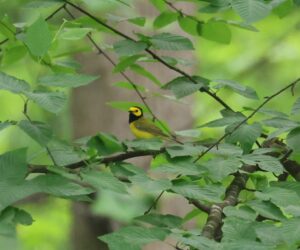
Hooded Warblers often alert you to their presence with their loud song. Seeing one in the tree cover is a bit tougher. Photo by participant Mattew Hauser.
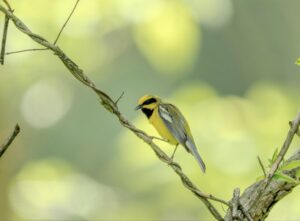
Although not a “countable species,” that didn’t stop our group from thoroughly enjoying this male Lawrence’s Warbler. Photo by participant Edward Paxton.
One of our field trips had fantastic looks at a Swainson’s Warbler—the second year this southern species has returned to the same exact stretch of hillside, singing his heart out looking for a mate. We also found two Yellow-throated Warblers (they love the towering sycamores). A few other birders found a Mississippi Kite. A decade or two ago seeing all of these species in Warren County, NJ in the same week would have been almost unthinkable.
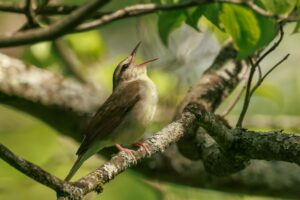
This Swainson’s Warbler has returned to the same stretch of Old Mine Rd for a second year. The closest areas where the species nests regularly are southern Virginia and southwestern Pennsylvania. Photo by associate naturalist Jonathan Klizas.
The march of southern species moving north seems undeniable.
There are more than warblers to see here: we were watching a beautiful Yellow-throated Vireo hopping around a walnut tree when it dropped into its delicate nest tucked in an outer branch. Overhead we heard the “Tee-Heeee!” call of Broad-winged Hawk and saw a few circling above us. Ravens cronked from over the Kittatinny Ridge. We caught quick looks at secretive Yellow-billed and Black-billed Cuckoos and watched a territorial battle between two Acadian Flycatchers. At Poxono Island, we counted over a dozen Spiny Softshell Turtles basking on the mudflats; their periscope-like snouts and smooth shells make them easy to identify. On my “Guides for Hire” trip we were fortunate to turn and spot a female Bobcat sitting at the edge of the road. She casually got up and walked away, melting back in the vegetation.
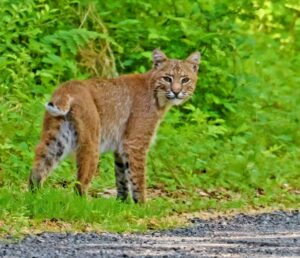
Once believed extirpated from the Garden State, Bobcats have made something of a comeback in northwestern New Jersey. These elusive cats are always a highlight of a day spent outdoors. Photo by associate naturalist Linda Mack.
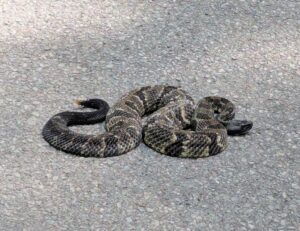
Along a nearby back road after one trip, Scott found this Timber Rattlesnake contentedly basking in the afternoon warmth. A wide berth was given, and the animal was not disturbed. Photo by Scott Barnes.
There’s always a twinge of sadness when I visit this area, witnessing the decline of the forest’s health. Eastern Hemlocks weakened or destroyed by the wooly adelgid pest. Ash trees killed by emerald ash borer beetles. While the standing dead ash trees may provide short-term nesting sites for woodpeckers and other cavity nesters, greater sunlight penetration allows for the expansion of invasive plants like Barberry, Autumn Olive, Stilt Grass, and Multiflora Rose. Some of the breeding bird species have adapted to nesting in this new understory; it’s heartening to see that birds like Wood Thrush and Hooded Warbler seem to be holding their own in this new landscape. There are more Eastern Towhees and Indigo Buntings than I recall some years ago, colonizing more open parts of the forest. I’m also proud to be part of an organization that is trying to protect, restore, and manage some of our woods and forests through pollinator ecology and conservation, Golden-winged Warbler conservation, and actions like the passage of Invasive Species Management Act. You can read more about the latter here: Landmark Invasive Species Management Act Signed | New Jersey Audubon