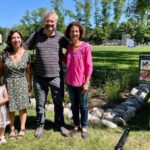
Joshua Covill and Scott Barnes, leaders.
Tour Narrative by Scott Barnes.
We began our tour with evening birding in Missoula at Council Grove State Park along the banks of the Clark Fork River. A highlight here was watching several Lewis’s Woodpeckers; these colorful and distinctive birds act like flycatchers, sallying forth from perches, catching insects in mid-air. We also watched one pop into its nest hole. The ponderosa pine forest here also hosted several Pygmy Nuthatches that gave us close views while they made their squeaky calls. We saw our only Calliope Hummingbirds of the tour here, with a male who perched for a few minutes allowing us to admire his streaked magenta throat. This uncommon hummer breeds mostly in the northern Rockies and Cascade Mountains.
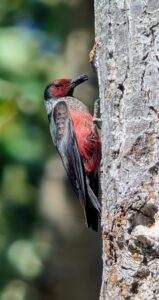
Lewis’s Woodpecker is a stunning woodpecker that acts more like a flycatcher, sallying out from exposed perches to catch insects. Photo by Scott Barnes.
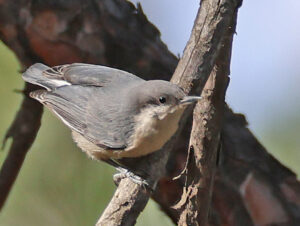
We had close views of a family of Pygmy Nuthatches, a species associated largely with ponderosa pines. Photo by Linda Mack.
A cool morning in the mountains along the west fork of Lolo Creek began with an adult and a recently fledged American Dipper bobbing on rocks in the creek. The spruce/fir-loving Hammond’s Flycatcher sang nearby, and we enjoyed scope views of Slate-colored Fox Sparrow. The Lolo Pass Visitor Center (5,233’) parking lot hosted Cassin’s Finches gritting close to our feet while a Rufous Hummingbird glowed hot orange in the meadow and a colorful male Lazuli Bunting sang. Just across the state line in Idaho, beautiful Packer Meadow was teeming with California Tortoiseshell butterflies. Two different Ruffed Grouse were drumming in the forest; their rapid wing beats created low-frequency thumping that could be heard and often felt (infrasound). An Olive-sided Flycatcher sang its “Quick Three Beers!” song and we had good views of Townsend’s Warbler and Mountain Chickadee. In the evening we ventured north to Ninepipe NWR’s wetlands where waterbirds included many Eared and Western Grebes, plus single Clark’s and Red-necked Grebes. It was a good stop for terns: among the numerous Forster’s we found several Black Terns and a Caspian Tern. At the end of our al-fresco dinner overlooking the beautiful Mission Mountains, Dave spotted a juvenile Great Horned Owl perched in a stand of willows.
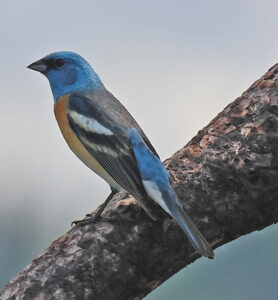
This cooperative male Lazuli Bunting was a stunner; this species was common in appropriate habitat throughout the tour. Photo by Linda Mack.
First on the agenda was a burned-over subalpine forest just outside Missoula for boreal woodpeckers at around 7,500’ with fabulous vistas stretching to the mountainous horizon. After much patience and persistence, we eventually got excellent looks at an American Three-toed Woodpecker. It seems like this scarce bird always makes one work for it! Despite hearing a calling Black-backed Woodpecker, we were unable to lure it into view. On our descent we stopped at the confluence of the Blackfoot and Clark Fork Rivers where we watched charismatic White-throated Swifts twitter and zoom overhead. After a midday respite we headed back into the mountains outside Missoula. Along the way we paused to admire a male Western Bluebird in a pasture. Higher up in the forest we spent time admiring a close and confiding flock of Evening Grosbeaks while they fed on the fresh tips of spruce needles—a great way to end the day’s birding!
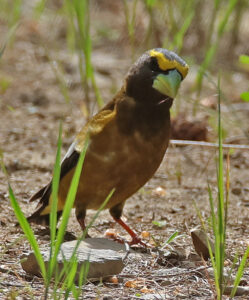
One of four Evening Grosbeaks we watched eat fresh spruce needle tips practically at our feet. Photo by Linda Mack.
We departed Missoula early and birded our way up another forest road in the Bitterroot Mountains. We were thrilled to have an extraordinary experience watching two male Dusky Grouse displaying. We could see their vocal sacks puffed out, but the sounds they make are basically imperceptible to human ears; their tails were fanned fully as they stomped their feet on the moss-covered forest floor. A highlight of the tour for many. Winding our way back down slope, we found another crowd-pleaser: a spectacular male Williamson’s Sapsucker that gave us excellent looks. After lunch in the cool town of Hamilton, we drove through the scenic Big Hole Valley to Dillon. That evening we enjoyed one of our most memorable experiences of the tour. In an exquisite high elevation area of open flower-studded meadows surrounded by spruce-fir forests we had an extended encounter with a Great Gray Owl. To our amazement, while enjoying and photographing this special bird an adult Northern Goshawk blew through the meadow, alighting in a dead tree briefly but long enough for everyone to have a good look. Topping off an unforgettable evening were two bugling Sandhill Cranes whose calls echoed across the landscape while a pair of Elk browsed at the forest edge.
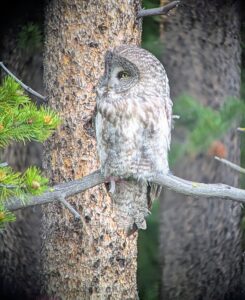
Great Gray Owl photo by Scott Barnes
In the southwest corner of Montana high elevation sagebrush habitat at around 6,000’ extended for miles. Driving to our first birding stop of the day we stumbled into a flock of 14 Greater Sage Grouse, an extremely lucky chance encounter! We spent the morning watching Sage Thrashers, Gray Flycatcher, Brewer’s Sparrow, and Sagebrush Sparrow, the latter here at the northern edge of its range. Josh showed us a Golden Eagle nest with a chick in a nearby valley. We broke up an afternoon drive with a roadside stop that gave us our best looks at Red-naped Sapsucker and another striking male Lazuli Bunting.
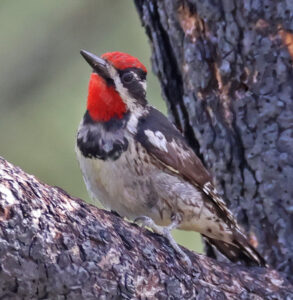
This brilliant Red-naped Sapsucker showed well for our group along Prickly Pear Creek. Photo by Linda Mack.
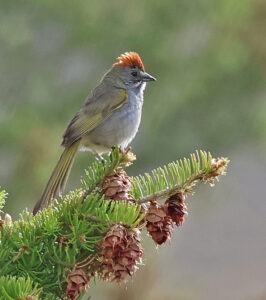
Green-tailed Towhees prefer scrubby hillsides with open juniper trees and brush. Photo by Linda Mack.
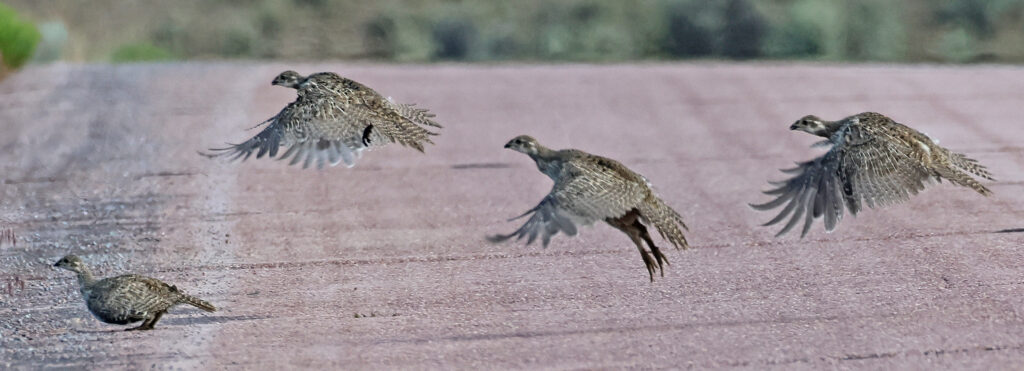
In the “How lucky can you get?” category was this surprise encounter with a flock of Greater Sage Grouse! Photo by Linda Mack.
When the hotel we had booked in Helena lost our reservations (it was their error), Josh and I came up with plan B and found lodging an hour south in Butte. Success on birding tours depends on many things. Adaptability and flexibility are among them. After a late check-in followed by a good meal at a downtown Irish Pub, we turned in for the night.
Close to town, we birded Herman Gulch, a pretty mix of riparian aspen groves along a creek with rocky hillsides with a mix of pine, spruce, and firs. The quiet landscape was broken only by the sounds of many birds including Hammonds and Dusky Flycatchers (the former on a nest), MacGillivray’s Warblers, Lincoln’s Sparrows, and Pink-sided Junco. A Rock Wren forsake its namesake and sang incessantly from a high spruce. Violet-green Swallows and Mountain Bluebirds brightened a pastoral cow pasture. A highlight at the road’s end was a Northern Pygmy-Owl being dive-bombed by a pair of angry American Robins. These cool little owls with their fake rear facing eye spots are always a treat to see. After lunch we did the long drive to the remote town of Harlowton in central Montana. A strong thunderstorm cut short some evening birding, so we turned in early, eager for what the morning would have in store.
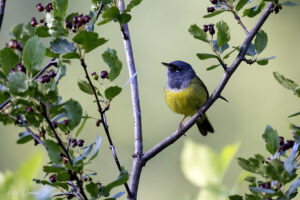
MacGillivray’s Warblers are generally skulky, often inhabiting dense streamside thickets. This cooperative bird showed uncharacteristically well! Photo by Donna Schulman.
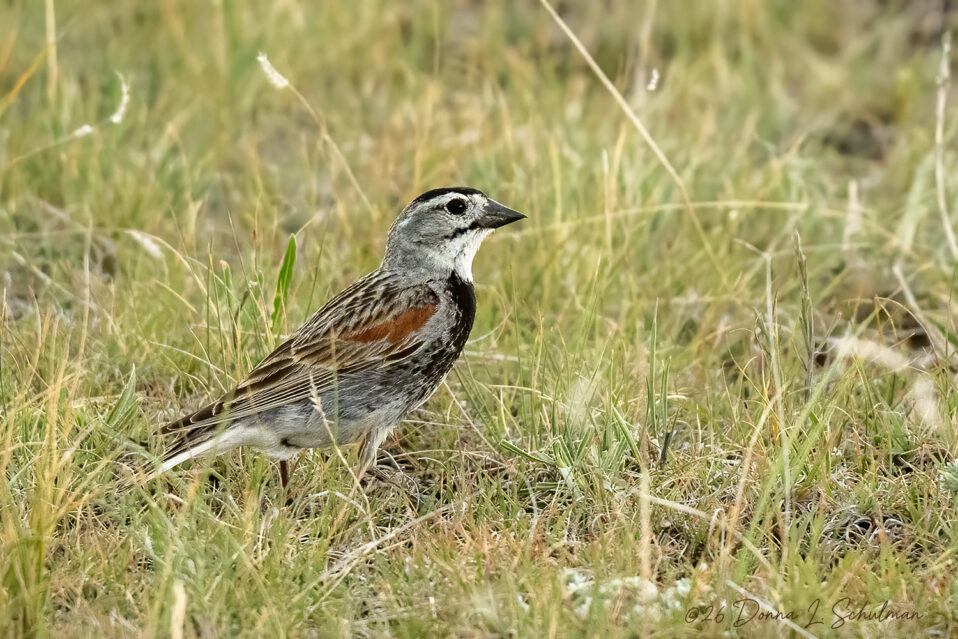
The day began cool, crisp, and calm as we explored the shortgrass prairie north of town, where the grasslands hosted dozens of displaying Thick-billed Longspur. Estimates vary, but up to 40% of the world population breeds in Montana. The males displayed and defended territories with a beautiful song given in flight combined with aerial displays by holding their wings in an upward V-position, showing off their pale heads, black bellies, and extensive white tail flashing. Not to be outdone, Chestnut-collared Longspurs were also present and doing their own flight displays, while Long-billed Curlews made their plaintive cries in the distance. Bold piebald Lark Buntings performed their version of flight displays, fluttering in the breeze that was beginning to build. Further up the road we encountered the sometimes elusive Sprague’s Pipit, another denizen of the northern prairies. Their thin, wiry song often alerts one to their presence. It’s often difficult to pick one out high in the sky as they hover in the blue, but Linda found it! They can’t hold that position forever, and eventually the bird dropped like a rock out of the sky and gave us excellent looks as it walked through the short grass and wildflowers. We tried hard for Baird’s Sparrow, but a stiff wind had picked up; we heard two birds but were unable to get a visual. More accommodating was a Say’s Phoebe nesting on an old barn and a Swainson’s Hawk perched on a fencepost.
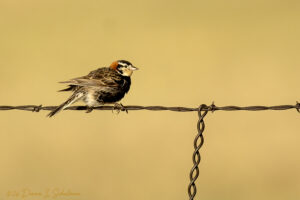
Chestnut-collared Longspur. Photo by Donna Schulman
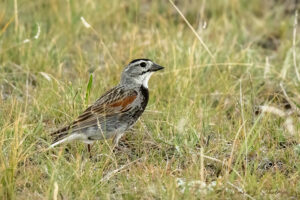
Thick-billed Longspur. Photo by Donna Schulman
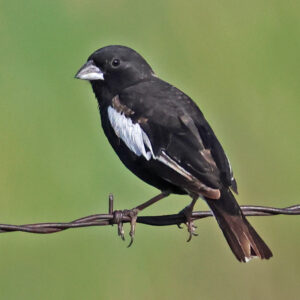
Lark Bunting photo by Linda Mack.
We travelled back to Great Falls for a nice dinner in town before visiting a White-tailed Prairie Dog town that evening. It was fun watching the antics of the prairie dogs, chirping away and constantly vigilant for predators. This colony is home to a few pairs of Burrowing Owls—one was perched atop a fencepost near the parking lot, and another light-morph Swainson’s Hawk was obliging.
Our final morning of birding was spent at Benton Lake NWR. This large shallow lake, adjacent wetlands, and mix of tallgrass and shortgrass prairie teem with wildlife, and we enjoyed flocks of Cinnamon Teal, over 200 Marbled Godwits, American Avocets, Wilson’s Phalaropes, and Franklin’s Gulls. We had fun watching a spiffy male Ruddy Duck displaying to a female, his head rapidly bobbing up and down while making an accelerated chugging sound and shaking his cocked tail. The grasslands were not to be ignored, with a few Upland Sandpipers, Northern Harriers, a Ferruginous Hawk being attacked by Red-winged Blackbirds, and our second Northern Goshawk of the trip, a juvenile that seemed lost out on the prairie. The roadsides had Horned Larks, more displaying Chestnut-collared Longspurs, and Vesper Sparrows. A great final stop for a successful and memorable tour!
Thanks to our outstanding leader and Montana native, Joshua Covill of Hillstar Nature Tours for planning such a great itinerary and overall trip. It was a pleasure to help co-lead the tour. Many, many thanks to our participants whose enthusiasm, flexibility, love of the natural world, and sense of humor made the tour a truly great experience. We can’t do it without you—thanks again!
Scott Barnes
Senior Naturalist
Cape May Bird Observatory-NJ Audubon
MAMMALS:
Red-tailed Chipmunk
Yellow-pine Chipmunk
Richardson’s Ground Squirrel
Golden-mantled Ground Squirrel
Columbian Ground Squirrel
Yellow-bellied Marmot
Red Squirrel
Eastern Gray Squirrel
Mountain Cottontail
Muskrat
Black-tailed Prairie Dog
Pronghorn
Mule Deer
White-tailed Deer
Coyote
Elk