Greetings to all from the Montclair Hawkwatch! I’m Peter, the counter at the Montclair Hawkwatch this season, and it’s a pleasure to be writing to you all today. As the watch enters its third week of open season, it’s always great to take some time to look back on weeks past and keep our fingers crossed for big flights in weeks ahead.
Here in Montclair, New Jersey, the Montclair Hawkwatch operates seven days a week (weather permitting) as myself and a handful of spectacular volunteers from the Montclair Bird Club keep our eyes glued to the sky for southbound migrants. After volunteering for a few days myself in the 2024 fall count, it was great to get reacquainted with the Hawkwatch property and local avifauna in the 2025 season. For those who haven’t made the trip over before, The Montclair Hawkwatch is New Jersey Audubon’s smallest preserve at just an acre. That acre primarily consists of a gravel platform at just below 600 feet in elevation, atop a massive basalt ledge which extruded from the earth during the Triassic Period, now known as part of the First Watchung Mountain. Ascending to that platform are 103 steps which snake up and through a crack in that basalt; from the platform itself, we’re granted a spectacular 180-degree view to the northeast, with panoramic views from the Highlands to the Palisades to New York City.
Those panoramic views also allow us to conduct the 66th year of the hawk count at Montclair. Montclair Hawkwatch is known for its exceptional flights of Broad-winged Hawks in mid to late September, but so far, any preemptions to these flights have eluded us. Usually, Montclair gets its best migratory flights of all species under northwest wind conditions, which drive migratory raptors closer to the coast; the First Watchung Mountain provides a last refuge of mountain air currents to send many migratory raptors southwest and away from the coastal plain. This year, our winds have consistently been in almost any direction except Northwest, so it’s been a slow two weeks with only a few migrants to speak of and no definitive sightings of Broad-winged Hawks. Data from other counts show decent flights over the central Appalachian chain to the west.
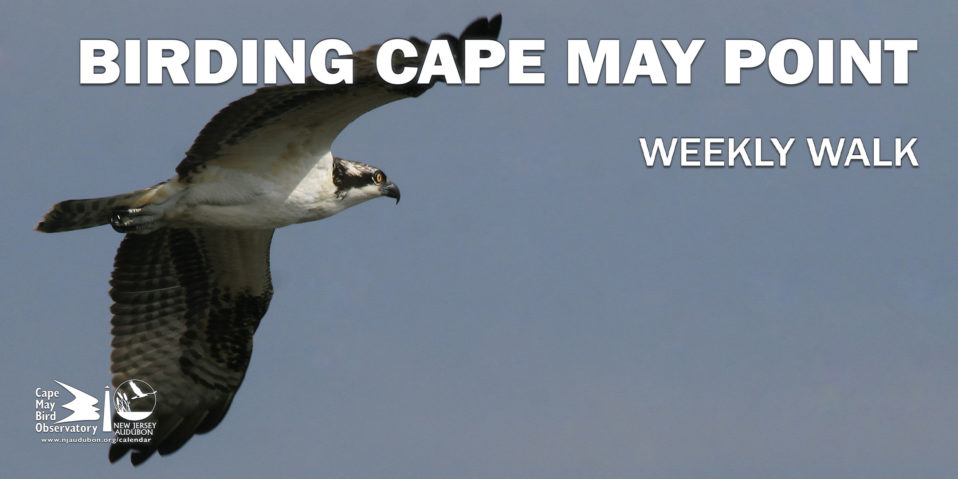
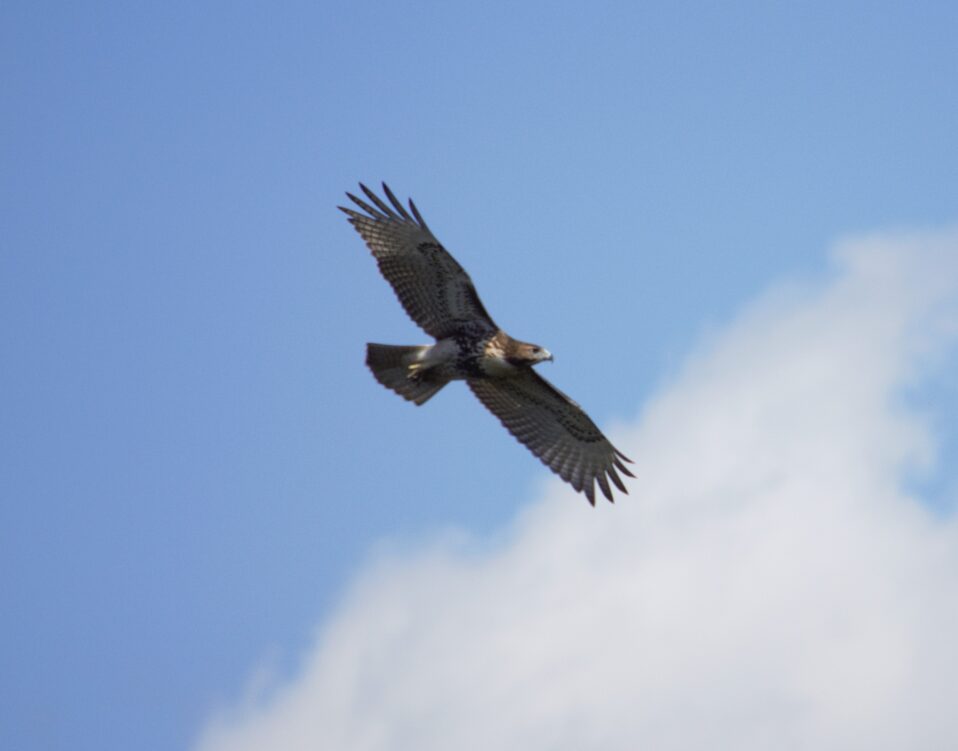
But even if we’re not swamped with migratory raptors just yet, these first two weeks have allowed us to get comfortable with the suite of local raptors which occupy the area and sometimes behold us with their aerial acrobatics. At least five different species of raptors can be seen from the Hawkwatch, and those are just what we’ve had this year. On days with good winds in any direction, all five species can be seen by a watchful eye in the span of a few minutes! At least seven Red-tailed Hawks can be seen soaring, kiting, hunting, and even having aerial sparring matches from the Montclair Hawkwatch. They’re a mix of adults and clumsy juveniles; some of these birds will occasionally land in the trees around the platform, or even on the basalt just below it. Accompanying the cohort of Red-tailed Hawks in the sky are a handful of Cooper’s Hawks, which give quite the show when chasing off many a raptor double their size with their long tails and darting flights characteristic of accipiters.
Complementing these more active predators are a large cohort of scavengers; Turkey Vultures are the numerous local raptor in the skies above the Hawkwatch, often seen by their shadow before they appear in their teetering flight style right overhead. Occasionally high above where the Turkey Vultures tend to glide are the Black Vultures, a little more graceful in their flights as they cruise between local green spaces looking for their next meal. Finally, we’re blessed to have a few Bald Eagles which call this region home and occasionally crisscross the skies above the Hawkwatch. Most often, we see them flying east or west between their nesting or feeding grounds in the Passaic River Basin and the Coastal Plain to the east.
In addition, these early weeks have profited from a good dispersion of migratory songbirds which sometimes alight on the bushes and trees surrounding the Hawkwatch in the early morning, some of which are a telltale sign of things to come: We’ve had Red-breasted Nuthatches consistently present during the count, definitively migrants far from their nearest breeding ranges. In addition, on September 14th, one of our volunteer counters Alex Bernzweig recorded the first Purple Finch of fall at the Hawkwatch; that’s the earliest sighting of a Purple Finch at the watch since 2020. Only time will tell if these early birds are a sign of migrants to come later.
Until then, we’ll keep our eyes glued to the sky here at Montclair Hawkwatch, with Friday, Sept 16th forecasted to be our first day of consistent Northwest winds. (Fingers crossed, knock wood!) Cheers to fall migration!
– Peter Roy
Red-tailed Hawk soaring over the Montclair Hawkwatch photo by Peter Roy